ลิ้งค์เชื่อมต่อ

ยานสำรวจของยุโรปสร้างประวัติศาสตร์ร่อนลงบนดาวหางได้สำเร็จ

French National Centre for Space Studies (CNES) president Jean-Yves Le Gall, left, French President Francois Hollande, center, and former French minister and astronaut Claudie Haignere, right, wear 3D glasses as they visit the Cite des Sciences at La Villette during a broadcast of the Rosetta mission as it orbits around comet 67/P Churyumov-Gersimenko in Paris,  Wednesday, Nov. 12, 2014. Hundreds of millions of miles from Earth, a European spacecraft made history Wednesday by successfully landing on the icy, dusty surface of a speeding comet — an audacious first designed to answer big questions about the universe. (AP Photo/Jacques Brinon, Pool)
French National Centre for Space Studies (CNES) president Jean-Yves Le Gall, left, French President Francois Hollande, center, and former French minister and astronaut Claudie Haignere, right, wear 3D glasses as they visit the Cite des Sciences at La Villette during a broadcast of the Rosetta mission as it orbits around comet 67/P Churyumov-Gersimenko in Paris, Wednesday, Nov. 12, 2014. Hundreds of millions of miles from Earth, a European spacecraft made history Wednesday by successfully landing on the icy, dusty surface of a speeding comet — an audacious first designed to answer big questions about the universe. (AP Photo/Jacques Brinon, Pool)

การเดินทางซึ่งใช้เวลานานถึง 10 ปีจะช่วยให้คำตอบเรื่องกำเนิดของสุริยะจักรวาล

please wait

No media source currently available

0:00 0:02:58 0:00
Direct link

องค์การอวกาศ European Space Agency ของยุโรปประกาศว่ายานสำรวจ Philae ซึ่งแยกตัวออกจากยานอวกาศ Rosetta ที่เริ่มเดินทางออกจากโลกเมื่อ 10 ปีที่แล้วสามารถร่อนลงบนดาวหาง 67P/Churyumov-Gerasimenko ได้สำเร็จ

Germany Rosetta Comet Landing

โดยดาวหาง 67P ซึ่งเคลื่อนที่อยู่ในบริเวณขอบสุริยะจักรวาลดังกล่าวมีอายุราว 4,600 ล้านปี อยู่ห่างจากโลกราว 500 ล้านกิโลเมตร และมีพื้นผิวหน้าเป็นหินปนน้ำแข็ง แต่การเดินทางของยานอวกาศต้องใช้เวลาถึง 10 ปีเป็นระยะทาง 6,000 ล้านกิโลเมตรเนื่องจากยานดังกล่าวต้องอาศัยแรงเหวี่ยงจากการโคจรรอบโลกรวมสามรอบและรอบดาวอังคารอีกหนึ่งรอบเพื่อให้สามารถทำความเร็วและไปไกลได้พอ

นักวิทยาศาสตร์หวังว่าการส่งยานสำรวจไปลงบนดาวหางอายุ 4,600 ล้านปีลูกนี้จะช่วยตอบคำถามเกี่ยวกับกำเนิดของสุริยะจักรวาล รวมทั้งเรื่องที่ว่าสิ่งมีชีวิตและน้ำบนพื้นโลกมาจากดาวหางต่างๆ ซึ่งโคจรอยู่ในอวกาศและตกลงสู่พื้นโลกเมื่อหลายพันล้านปีที่แล้วจริงหรือไม่

ภาพยานสำรวจของยุโรปลงจอดบนดาวหาง

This OSIRIS wide-angle camera image shows the position of Rosetta’s lander Philae (circled) on Nov. 12, 2014. (Courtesy: European Space Agency, photo released Nov. 13, 2014)
1/10 This OSIRIS wide-angle camera image shows the position of Rosetta’s lander Philae (circled) on Nov. 12, 2014. (Courtesy: European Space Agency, photo released Nov. 13, 2014)
Rosetta’s lander Philae is safely on the surface of Comet 67P/Churyumov-Gerasimenko, as these first two CIVA images confirm. One of the lander’s three feet can be seen in the foreground. The image is a two-image mosaic, Nov. 13, 2014. (Courtesy: European Space Agency, photo released Nov. 13, 2014)
2/10 Rosetta’s lander Philae is safely on the surface of Comet 67P/Churyumov-Gerasimenko, as these first two CIVA images confirm. One of the lander’s three feet can be seen in the foreground. The image is a two-image mosaic, Nov. 13, 2014. (Courtesy: European Space Agency, photo released Nov. 13, 2014)
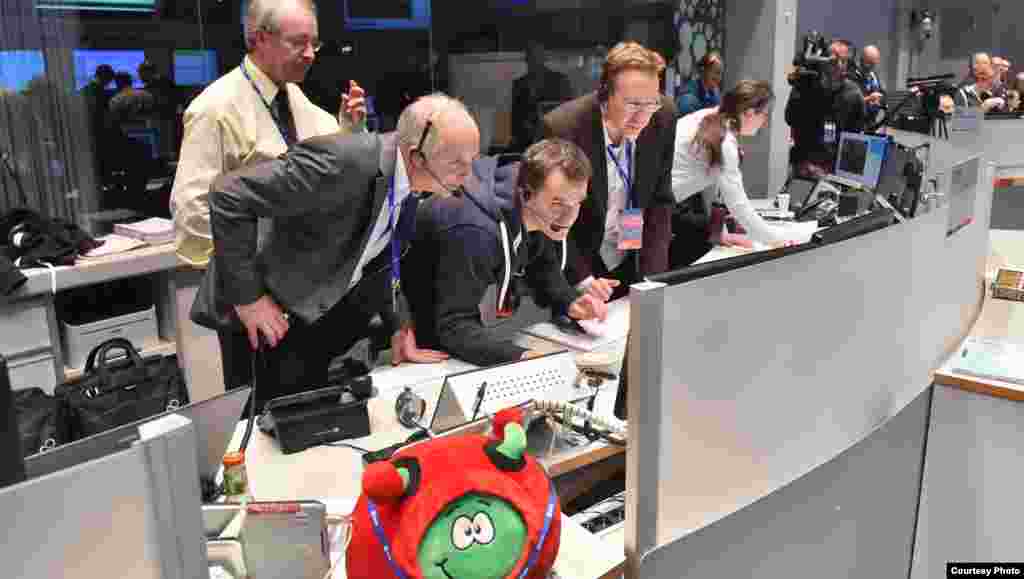
Smiles in the Main Control Room at ESA's Operations Center, as separation of the Philae lander from ESA Rosetta orbiter is confirmed and the Philae lander on its way to becoming the first spacecraft to touch down on a comet, Nov. 12, 2014. (Courtesy: Euro
3/10 Smiles in the Main Control Room at ESA's Operations Center, as separation of the Philae lander from ESA Rosetta orbiter is confirmed and the Philae lander on its way to becoming the first spacecraft to touch down on a comet, Nov. 12, 2014. (Courtesy: Euro
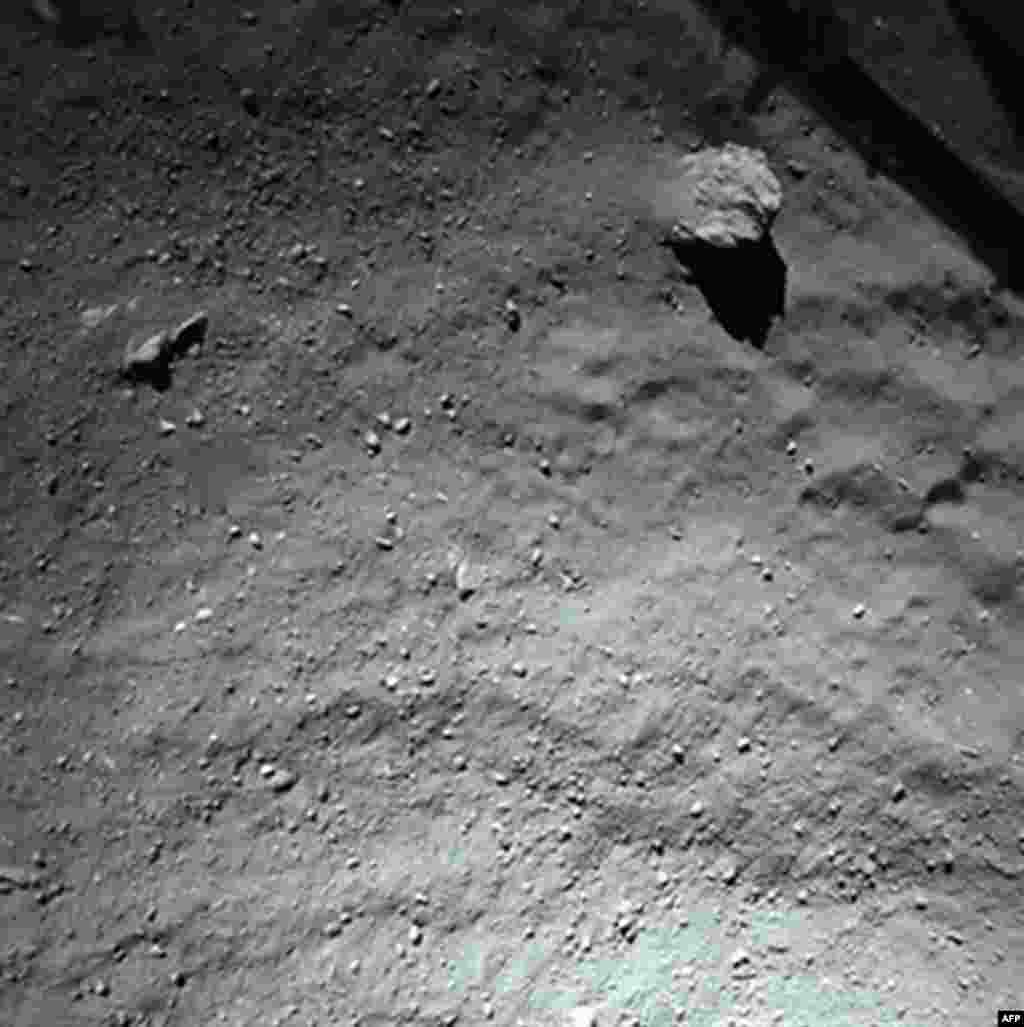
A handout photo released on November 13, 2014 by the European Space Agency, and taken by the Rosetta Lander Imaging System instrument, shows the surface of comet 67P/Churyumov-Gerasimenko during Philae's descent, from a distance of approximately 40 meters above the surface. (Courtesy: European Space Agency)
4/10 A handout photo released on November 13, 2014 by the European Space Agency, and taken by the Rosetta Lander Imaging System instrument, shows the surface of comet 67P/Churyumov-Gerasimenko during Philae's descent, from a distance of approximately 40 meters above the surface. (Courtesy: European Space Agency)
Receipt of signal from comet surface just after Philae landed, Nov. 12, 2014. (Courtesy: European Space Agency)
5/10 Receipt of signal from comet surface just after Philae landed, Nov. 12, 2014. (Courtesy: European Space Agency)
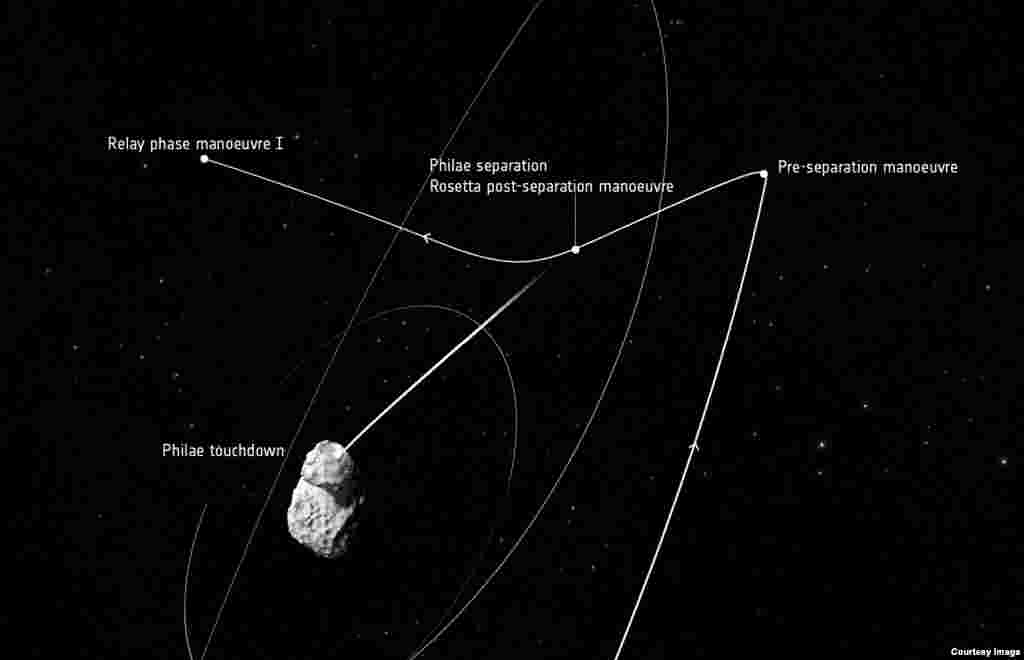
Trajectory of Rosetta’s orbit, focusing on the maneuvers of Nov. 12. (Courtesy: European Space Agency)
6/10 Trajectory of Rosetta’s orbit, focusing on the maneuvers of Nov. 12. (Courtesy: European Space Agency)
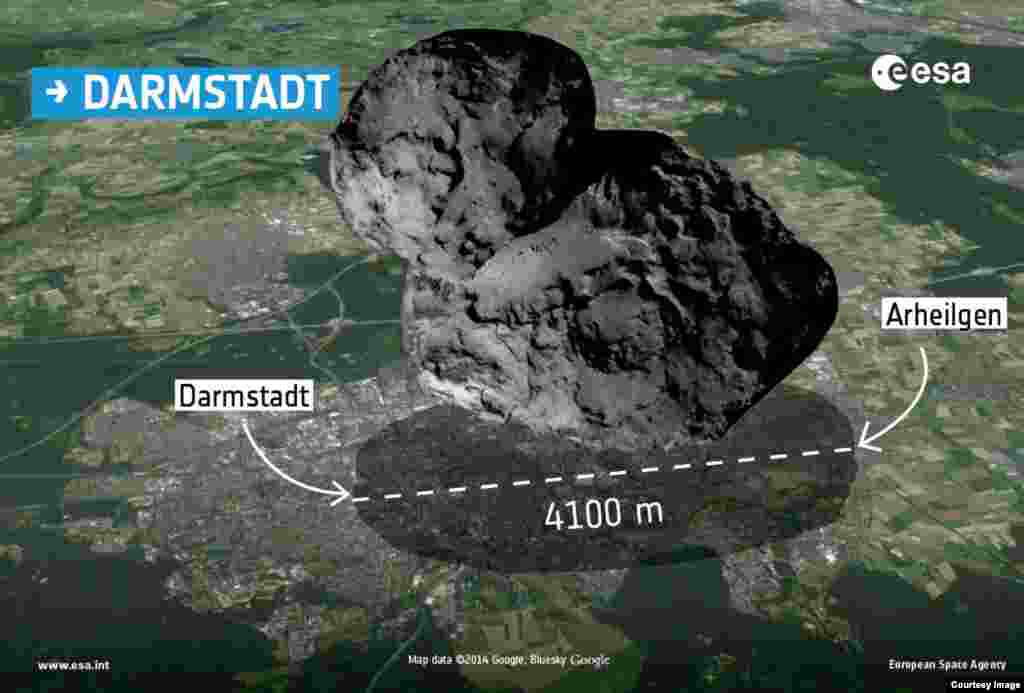
Comparing the size of Comet 67P/Churyumov–Gerasimenko with the city of Darmstadt, Germany, home to the European Space Operations Center. (Courtesy: European Space Agency, Google maps)
7/10 Comparing the size of Comet 67P/Churyumov–Gerasimenko with the city of Darmstadt, Germany, home to the European Space Operations Center. (Courtesy: European Space Agency, Google maps)
Artist impression showing Philae separating from Rosetta and descending to the surface of comet 67P/Churyumov-Gerasimenko. (Courtesy: European Space Agency)
8/10 Artist impression showing Philae separating from Rosetta and descending to the surface of comet 67P/Churyumov-Gerasimenko. (Courtesy: European Space Agency)
This image from Rosetta’s OSIRIS narrow-angle camera is marked to show the location of the first touchdown point of the Philae lander. It is thought that Philae bounced twice before settling on the surface of Comet 67P/Churyumov-Gerasimenko, Nov. 12, 2014. (Courtesy: European Space Agency)
9/10 This image from Rosetta’s OSIRIS narrow-angle camera is marked to show the location of the first touchdown point of the Philae lander. It is thought that Philae bounced twice before settling on the surface of Comet 67P/Churyumov-Gerasimenko, Nov. 12, 2014. (Courtesy: European Space Agency)
Celebrating scientists in the main control room appear on a video screen at the European Space Agency after the first unmanned spacecraft Philae landed on a comet called 67P/Churyumov-Gerasimenko, in Darmstadt, Germany, Nov. 12, 2014.

10/10 Celebrating scientists in the main control room appear on a video screen at the European Space Agency after the first unmanned spacecraft Philae landed on a comet called 67P/Churyumov-Gerasimenko, in Darmstadt, Germany, Nov. 12, 2014.

Previous slide
Next slide

เกี่ยวข้อง

XS
SM
MD
LG