



ลิ้งค์เชื่อมต่อ

สิ่งมีชีวิตใต้ทะเลที่อาศัยก๊าซมีเทนในการดำรงชีวิต สร้างระบบนิเวศน์เล็กๆ สำหรับ microbe บริเวณก้นมหาสมุทรด้วย

<span style="font-size:11.0pt">Microscopic image of a group of multi-celled methane-oxidizing microbes found in deep-sea methane seeps in Hydrate Ridge, Oregon. (S. McGlynn, Caltech</span>)
1/12 Microscopic image of a group of multi-celled methane-oxidizing microbes found in deep-sea methane seeps in Hydrate Ridge, Oregon. (S. McGlynn, Caltech)
<span style="font-size:11.0pt">Microscopic image of methane-oxidizing microbes recovered from deep-sea methane seep sediments.&nbsp;&nbsp; Methane-oxidizing Archaea are stained with DNA probe in green, associated symbiotic bacteria are stained in blue.&nbsp; The orange-yellow materials are sediment particles.&nbsp; (S. McGlynn, Caltech</span>)
2/12 Microscopic image of methane-oxidizing microbes recovered from deep-sea methane seep sediments.   Methane-oxidizing Archaea are stained with DNA probe in green, associated symbiotic bacteria are stained in blue.  The orange-yellow materials are sediment particles.  (S. McGlynn, Caltech)
<span style="font-size:11.0pt">Using the manipulator arm of the submersible Alvin to collect carbonate and associated animals from an active methane seep off the coast of Costa Rica.&nbsp; (L. Levin, SIO</span>)
3/12 Using the manipulator arm of the submersible Alvin to collect carbonate and associated animals from an active methane seep off the coast of Costa Rica.  (L. Levin, SIO)
<span style="font-size:11.0pt">Manipulator arm of Alvin submersible collecting piece of carbonate from the ledge of the methane seep, Costa Rica Margin, 1,000 meters deep. (V. Orphan</span>)
4/12 Manipulator arm of Alvin submersible collecting piece of carbonate from the ledge of the methane seep, Costa Rica Margin, 1,000 meters deep. (V. Orphan)
<span style="font-size:11.0pt">Carbonate slab collected from Costa Rica Margin seep, with associated worms, snails and limpets.&nbsp; (G. Rouse</span>)
5/12 Carbonate slab collected from Costa Rica Margin seep, with associated worms, snails and limpets.  (G. Rouse)
<span style="font-size:11.0pt">A piece of deep-sea carbonate ledge in the manipulator claw with attached white sulfide oxidizing bacterial filaments and anemone, from the Eel River Basin, off the California coast, 550 meters deep. (V. Orphan</span>)
6/12 A piece of deep-sea carbonate ledge in the manipulator claw with attached white sulfide oxidizing bacterial filaments and anemone, from the Eel River Basin, off the California coast, 550 meters deep. (V. Orphan)
<span style="font-size:11.0pt">Submersible Alvin about to be launched from the back deck of the R/V Atlantis, Costa Rica Margin. (V. Orphan</span>)
7/12 Submersible Alvin about to be launched from the back deck of the R/V Atlantis, Costa Rica Margin. (V. Orphan)
<span style="font-size:11.0pt">View of R/V Atlantis ship from inside Alvin after a successful dive to the methane seeps off of Hydrate Ridge, Oregon.&nbsp; (V. Orphan</span>)
8/12 View of R/V Atlantis ship from inside Alvin after a successful dive to the methane seeps off of Hydrate Ridge, Oregon.  (V. Orphan)
<span style="font-size:11.0pt">Sponges colonizing carbonates from a dormant methane seep site, Eel River Basin, California. (V. Orphan</span>)
9/12 Sponges colonizing carbonates from a dormant methane seep site, Eel River Basin, California. (V. Orphan)
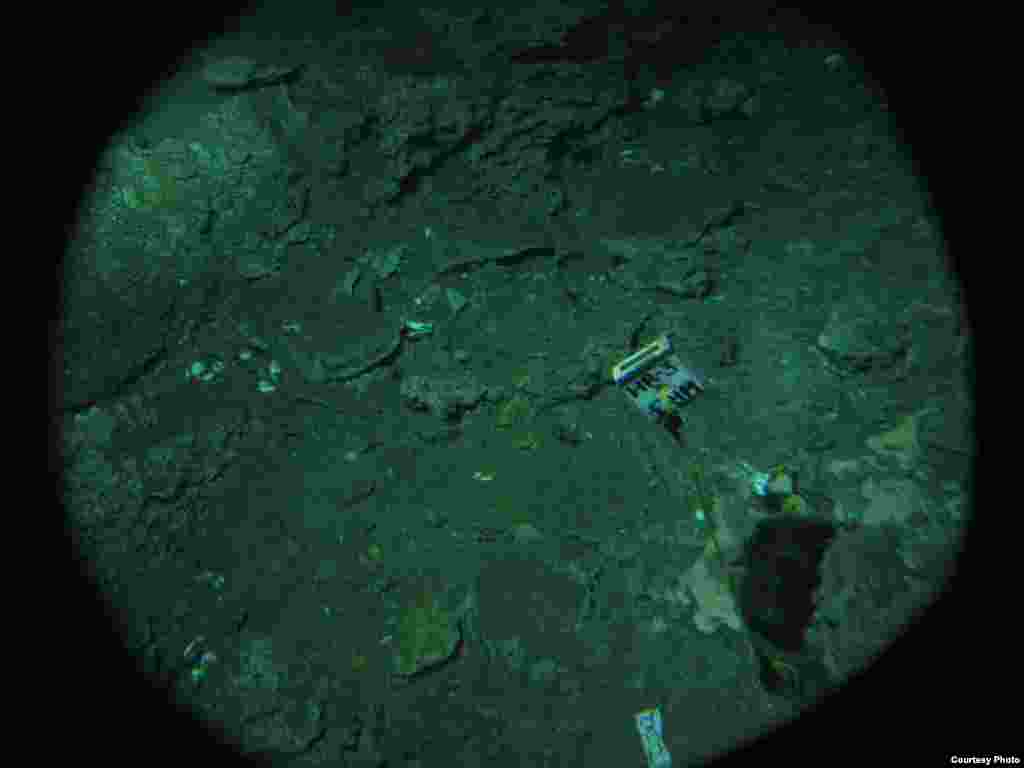
<span style="font-size:11.0pt">View from inside Alvin of carbonate pavement and boulders in an area of methane seepage from Hydrate Ridge, Oregon, 700 meters deep. (V. Orphan</span>)
10/12 View from inside Alvin of carbonate pavement and boulders in an area of methane seepage from Hydrate Ridge, Oregon, 700 meters deep. (V. Orphan)
<span style="font-size:11.0pt">Mussels nestled within exposed carbonate mound in an active methane seep. Costa Rica Margin, 1,000 meter water depth. (V. Orphan</span>)
11/12 Mussels nestled within exposed carbonate mound in an active methane seep. Costa Rica Margin, 1,000 meter water depth. (V. Orphan)
<span style="font-size:11.0pt">California Institute of Technology geobiology class on a field trip to a paleo-methane seep outcrop in Panoche Hills, California.&nbsp; These ancient seep carbonates are Cretaceous-aged (~100-66 million years ago),&nbsp; extend nearly 20 kilometers and are approximately 200 meters thick in some areas. (V. Orphan</span>)
12/12 California Institute of Technology geobiology class on a field trip to a paleo-methane seep outcrop in Panoche Hills, California.  These ancient seep carbonates are Cretaceous-aged (~100-66 million years ago),  extend nearly 20 kilometers and are approximately 200 meters thick in some areas. (V. Orphan)
Previous slide
Next slide
please wait

No media source currently available

0:00 0:02:27 0:00
Direct link

นักชีววิทยา Victoria Orphan จาก California Institute of Technology ศึกษาสิ่งมีชีวิตขนาดเล็กใต้มหาสมุทรและพบว่า ไม่เพียงแต่พวกมันจะสามารถใช้ชีวิตโดยอาศัยก๊าซมีเทน แต่ยังสร้างระบบนิเวศน์เล็กๆสำหรับสิ่งมีชีวิตบริเวณก้นทะเลด้วย

เธอเดินทางสู้ก้นบึ้งมหาสมุทรลึก 800 เมตรเพื่อเก็บตัวอย่างตะกอนมาวิจัย เพื่อยืนยันข้อสันนิษฐานดังกล่าว ซึ่งเธอพบว่า การปล่อย calcium carbonate โดยสิ่งมีชีวิตที่ใช้มีเทนในการดำรงชีวิต ทำให้เกิดเนินใต้น้ำที่เป็นแหล่งที่อยู่ของ microbe ลักษณะคล้ายกันด้วย

การค้นพบครั้งนี้ ช่วยอธิบายด้วยว่าสิ่งมีชีวิตเล็กๆ ใต้ทะเลเหล่านี้ช่วยควบคุมระดับมีเทนในทะเลให้ต่ำและไม่ลอยขึ้นเหนือชั้นบรรยากาศ

โปรดติดตามรายละเอียดจากคลิปเรื่องนี้ในรายการข่าวสดสายตรงจากวีโอเอ

รายงานโดย Rosanne Skirble/เรียบเรียงโดย Rattaphol Onsanit

เกี่ยวข้อง

XS
SM
MD
LG